
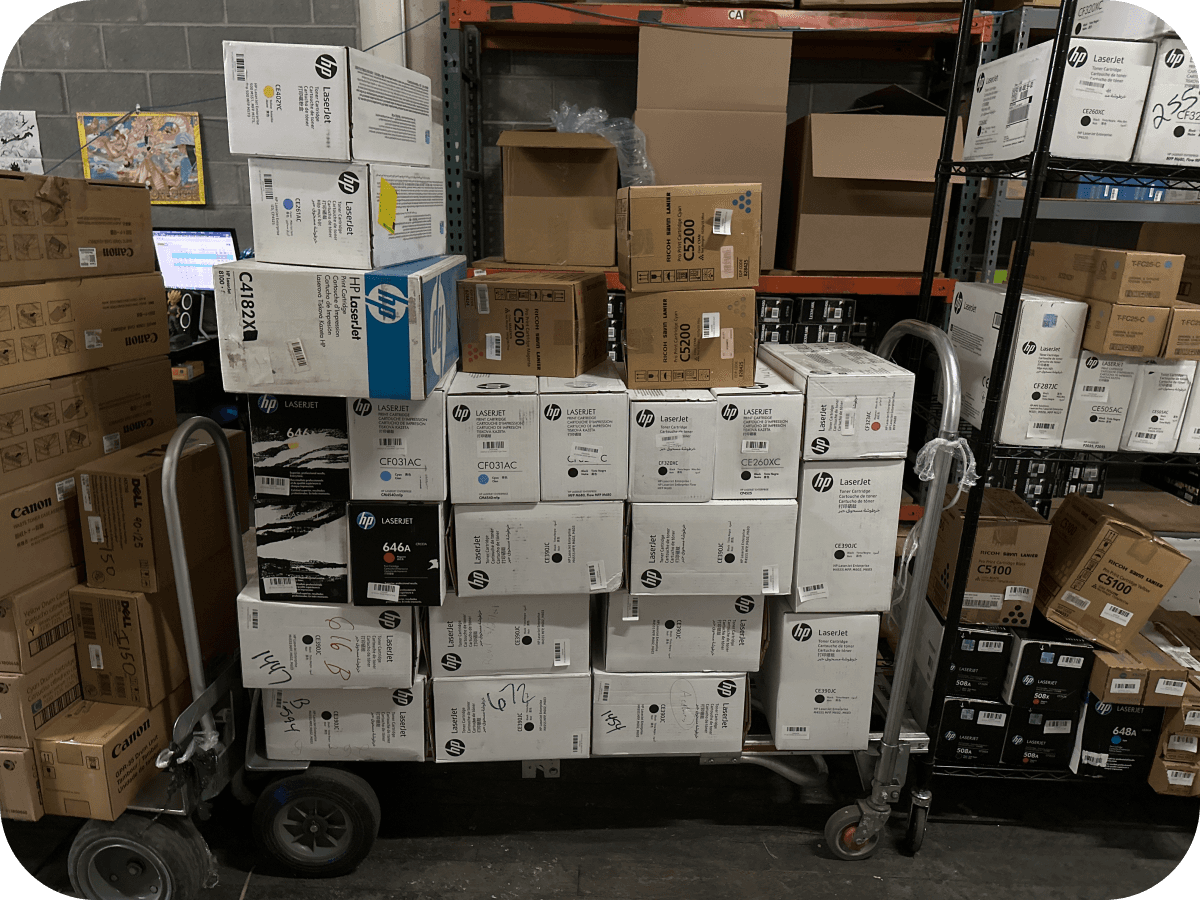
Sell Toner in Bulk: A Guide for Offices With Surplus Cartridges
Offices can sell toner in bulk by inventorying unused cartridges, confirming exact model numbers, documenting condition, and requesting quotes from qualified buyers. Factory-sealed OEM toner generally has stronger resale potential. Bulk selling is especially useful after printer upgrades, office closures, relocations, over-ordering, or changes to managed print services.

What Does It Mean to Sell Toner in Bulk?
Selling toner in bulk means offering multiple unused toner cartridges together instead of selling each cartridge individually.
Bulk inventories can contain one model or dozens of different SKUs. Specialized toner buyers can evaluate an inventory list and make an offer for qualifying products. Toner Connect identifies office managers, IT resellers, and businesses with excess inventory as common bulk sellers.
Useful definitions:
- Bulk toner: Multiple toner cartridges being offered in one transaction.
- Surplus toner: Toner an organization owns but no longer expects to use.
- OEM toner: Toner made or branded by the printer’s original equipment manufacturer.
- SKU: A product identifier used to distinguish one cartridge model from another.
- Factory sealed: Original packaging that has not been opened.
These distinctions matter because toner buyers may have different purchasing requirements.
Why Do Offices Have Surplus Toner to Sell?
Offices usually accumulate surplus toner when purchasing decisions no longer match their active printer fleet.
Printer upgrades can immediately make older cartridge models unnecessary. Downsizing and hybrid-work changes can also reduce printing demand. Toner Connect’s 2025 office guide identifies printer upgrades, overstock purchasing, remote-work transitions, and changing business needs as common causes.
Other common causes include:
- Buying too much toner.
- Switching printer brands.
- Replacing an entire printer fleet.
- Moving or closing an office.
- Consolidating departments.
- Changing managed print providers.
- Ordering the wrong cartridges.
Surplus toner is therefore not necessarily defective or expired.
Which Offices Are Most Likely to Sell Toner in Bulk?
Large offices, multi-location businesses, schools, government departments, and IT teams are particularly likely to encounter bulk surplus toner.
The reason is scale. More printers can mean more cartridge models and more backup inventory.
Why Might Corporate Offices Need to Sell Toner?
Corporate offices often find surplus cartridges after downsizing, relocating, or replacing printer fleets.
Toner Connect identifies company downsizing, relocation, printer upgrades, and managed-print changes as common reasons for bulk toner liquidation.
A multi-floor office can also discover separate toner stockpiles during a centralized inventory audit.
Why Might IT Departments Have Bulk Toner to Sell?
IT departments can inherit surplus toner when they standardize printers or retire older equipment.

A fleet migration may replace several printer models with one standardized platform. Toner for the retired devices can remain unopened even though the business no longer has compatible machines. Toner Connect identifies equipment replacement as a common source of surplus inventory.
IT teams should check toner storage before disposing of old printers.
Why Might Schools Have Large Toner Inventories?
Schools can accumulate bulk toner through centralized purchasing, equipment upgrades, and funding or purchasing cycles.
Toner Connect’s January 2026 guide identifies bulk purchasing, grant funding cycles, and equipment upgrades as reasons schools and government offices accumulate surplus toner.
Schools should follow district property and procurement rules before selling institution-owned supplies.
Why Might Office Closures Produce Large Toner Lots?
Office closures can reveal toner that was distributed across supply rooms, departments, and storage areas.
Closure teams often need to clear inventory within a fixed timeline. Toner Connect identifies bulk buyers as a practical option for office managers, closure teams, and IT asset disposition workflows.
A single consolidated inventory can simplify the process.
What Types of Toner Are Easier to Sell in Bulk?
Factory-sealed OEM cartridges generally have stronger bulk resale potential than opened or poorly documented supplies.
Buyers need confidence about what they are purchasing. Toner Connect’s August 2026 preparation guide emphasizes confirming OEM status, checking factory seals, recording exact models, and documenting box condition.
Common OEM brands include:
- HP
- Canon
- Brother
- Xerox
- Lexmark
- Ricoh
Acceptance is buyer-specific.
Do not assume compatible, remanufactured, opened, or damaged cartridges will receive the same treatment as sealed OEM toner.
Why Does Factory-Sealed Condition Matter When You Sell Toner?
Factory-sealed packaging helps demonstrate that a cartridge remains unused.
Condition is important in a resale transaction. Buyers may discount or reject cartridges with missing seals, water damage, heat damage, or missing labels.
Inspect each box for:
- Intact manufacturer seals
- Water damage
- Crushed corners
- Tears
- Fading
- Missing labels
- Heavy writing
- Mold or moisture damage
Do not open a sealed cartridge merely to inspect what is inside.
What Information Should an Office Collect Before Selling Toner?
Record the manufacturer, exact cartridge model, quantity, OEM status, seal status, and packaging condition.
Accurate identification helps buyers evaluate an inventory without unnecessary back-and-forth. Toner Connect recommends sorting toner by brand and model, checking box condition, and recording quantities before selling in bulk.
A spreadsheet can look like this:
| Brand | Model | Color | Quantity | Condition |
|---|---|---|---|---|
| HP | W2020X | Black | 18 | Factory sealed |
| Brother | TN-850 | Black | 12 | Factory sealed |
| Canon | 055 | Cyan | 7 | Factory sealed |
| Xerox | Exact model | Magenta | 5 | Box wear |
Photographs can provide additional evidence of condition.
Why Is the Exact Toner Model Number So Important?
The exact model number tells a buyer precisely which cartridge is being offered.
A description such as “HP black toner” is too broad for an accurate quote. Different yield versions and printer families can have similar-looking packaging.
Toner Connect recommends providing exact model numbers when preparing unused cartridges for resale.
Copy the number directly from the cartridge box.
Do not substitute the printer’s model number.
How Should an Office Audit a Large Toner Inventory?
Audit bulk toner by location first and then organize the cartridges by brand, model, quantity, and condition.
This approach prevents the same cartridge from being counted twice. It also exposes toner hidden in departmental storage.

A practical audit can follow these steps:
- Check every supply location.
- Separate toner from other printer supplies.
- Group boxes by manufacturer.
- Sort each manufacturer by model.
- Count identical cartridges.
- Inspect factory seals.
- Record packaging damage.
- Photograph larger groups.
- Enter everything into one master spreadsheet.
Toner Connect recommends organizing inventory before requesting bulk pricing because accurate records can reduce delays and pricing mistakes.
Should Offices Sell Toner Individually or in Bulk?
Bulk selling is usually more practical when an office has many cartridges and wants to reduce the work involved in individual transactions.
Selling cartridges individually can require separate listings, photographs, customer messages, shipping, and possible returns. A specialized buyer can be more practical for a large office cleanout involving dozens or hundreds of boxes.
The trade-off is important.
Individual marketplace listings can provide greater control over asking prices. Bulk sales can reduce administrative effort.
The best choice depends on the office’s priorities.
How Does a Small Office Differ From a Large Corporate Seller?
Small offices can prioritize per-cartridge value, while large offices often need to balance value against time and administrative effort.
A business selling four cartridges faces a different workload from a corporation clearing 400 boxes. Toner Connect recommends comparing marketplaces, local resellers, and specialized buyers instead of assuming one selling channel is best for every inventory.
For a small office, individual listings may be manageable.
For a large office, processing hundreds of separate transactions can become costly in staff time.
How Can Multi-Location Companies Sell Toner More Efficiently?
Multi-location companies should consolidate inventory data before deciding whether physical toner needs to be consolidated.
Start with one spreadsheet covering every branch.
Add a Location column so the buyer knows where each group is stored.
For example:
| Location | Model | Quantity | Condition |
|---|---|---|---|
| Dallas office | HP W2020X | 20 | Sealed |
| Phoenix office | HP W2020X | 15 | Sealed |
| Chicago office | Brother TN-850 | 10 | Sealed |
Toner Connect identifies office closures, relocation, and corporate inventory changes as common bulk-selling situations.
Ask the buyer whether multiple pickup or shipping locations affect the quote.
Does Location Matter When Offices Sell Toner?
Location matters primarily because it can affect shipping, logistics, and access to local buyers.
A local reseller may be convenient when the office is in a large metropolitan market. An online buyer can broaden options when local demand is limited.
Toner Connect’s local selling guide identifies both local and online routes for unused toner.
Offices should compare net value, not simply the highest advertised purchase price.
How Is Bulk Toner Value Determined?
Bulk toner value depends on the specific products, quantities, condition, and buyer demand.
There is no reliable universal price per cartridge.
A buyer may consider:
- Manufacturer
- Exact SKU
- OEM status
- Quantity
- Factory-seal status
- Box condition
- Product age
- Current resale demand
Toner Connect’s bulk-selling guidance recommends researching product value and accounting for shipping when evaluating a bulk sale.
Original retail price is not the same as current resale value.
Should Offices Compare the Offer or the Net Return?
Offices should compare the net return because fees and shipping can reduce the value of a higher headline offer.
A marketplace transaction may include selling fees and shipping expenses. A direct buyer may structure those costs differently.
Toner Connect’s toner buyer guide warns that a higher advertised price does not necessarily create a higher net return when fees and shipping apply.
A simple comparison is:
Net return = payment received − selling fees − seller-paid shipping − other transaction costs
Staff time can also matter for very large inventories.
How Should Offices Compare Bulk Toner Buyers?
Compare eligibility, net payment, shipping, inspection rules, and payment terms before choosing a buyer.
Price is only one part of the transaction.
Ask each buyer:
- Which cartridge types do you accept?
- Do products need to be factory sealed?
- Who pays shipping?
- Can the quote change after inspection?
- What happens to rejected cartridges?
- How quickly is payment issued?
- Are there payment fees?
- Can you handle multiple office locations?
Written answers make competing offers easier to compare.
Can Toner Connect Help Offices Sell Toner in Bulk?
Toner Connect is one option for businesses seeking to sell qualifying surplus toner without creating individual consumer listings.
The company publishes guidance specifically for online and bulk toner sales. Its January 2026 guide recommends auditing inventory, documenting exact models and condition, and selecting a selling route based on the seller’s needs.
Offices can start at Toner Connect.
Useful internal resources include How to Sell Toner Online and in Bulk in 2026 and How to Prepare Unused Cartridges for Resale.
Always confirm current eligibility before shipping inventory.
What Should Schools or Government Offices Check Before They Sell Toner?
Public institutions should confirm their own surplus-property, procurement, and approval rules before selling toner.
Institution-owned toner may be subject to procedures that do not apply to a private business.
Toner Connect’s January 2026 guide recommends clear procedures when schools and government organizations dispose of or sell surplus toner.
Government organizations may also need an audit trail showing authorization, inventory, sale terms, and disposition.
The exact requirements depend on the organization and jurisdiction.
What Should an Office Do With Toner That Cannot Be Sold?
Offices should investigate reuse, manufacturer take-back, remanufacturing, or appropriate recycling when toner cannot be resold.
The EPA states that spent toner cartridges can be returned to a manufacturer or remanufacturer for refilling, refurbishment, cleaning, and resale. The EPA page was updated in March 2026.
Do not confuse spent cartridges with unopened surplus toner.
A factory-sealed cartridge with current demand may still be suitable for resale.
What 2024–2026 Statistics Put Surplus Toner in Context?
Current waste statistics show the broader importance of keeping usable products and materials in circulation, although the figures are not toner-specific.
The Global E-waste Monitor 2024 reported that the world generated 62 billion kilograms of e-waste in 2022. Only 22.3% was documented as formally collected and recycled.
The report projects global e-waste generation could reach 82 billion kilograms by 2030 under its outlook.
These are broad electronic-waste figures.
They are not statistics for toner cartridges or office toner waste.
What Mistakes Should Offices Avoid When Selling Toner?
Offices should avoid opening sealed toner, guessing model numbers, hiding damage, and shipping inventory before confirming transaction terms.
Bulk sales depend heavily on accurate information.
Toner Connect’s 2026 guide recommends honest condition descriptions and exact model numbers for bulk listings.
Common mistakes include:
- Opening factory-sealed boxes
- Mixing OEM and compatible toner
- Using printer models instead of cartridge SKUs
- Miscounting inventory
- Ignoring damaged packaging
- Comparing gross prices instead of net returns
- Shipping without written terms
- Packing toner loosely
A careful inventory reduces avoidable disputes.
How Should Offices Pack Toner After Accepting an Offer?
Offices should protect retail toner boxes from crushing, moisture, and movement during shipment.
Large shipments create different risks from mailing one cartridge.
Use sturdy outer cartons and suitable cushioning.
Group cartridges logically when possible.
Label multi-box shipments consistently.
Follow the buyer’s instructions before arranging freight or parcel shipping.

How Can Offices Prevent Another Toner Surplus?
Offices can reduce future surplus by linking toner purchasing to active printer models and current inventory.
Printer upgrades should trigger a toner inventory review.
A simple prevention system includes:
- Maintain a central toner inventory.
- Record exact cartridge SKUs.
- Match every SKU to active printers.
- Check inventory before purchasing.
- Review toner before printer upgrades.
- Transfer compatible toner between departments.
- Set reasonable backup-stock levels.
- Audit storage periodically.
Toner Connect identifies printer upgrades, overstocking, downsizing, and changing business needs as recurring causes of unused office toner.
Preventing surplus is easier than discovering obsolete inventory years later.
What Is the Best Way for an Office to Sell Toner in Bulk?
The best approach is to inventory the cartridges accurately, preserve their condition, compare net offers, and choose a buyer that fits the size and complexity of the office cleanout.
An office with five cartridges does not have the same needs as a corporation clearing hundreds of boxes. Large sellers should pay particular attention to shipping, inspection terms, payment procedures, and administrative workload.
If your office has qualifying factory-sealed OEM inventory, Toner Connect is one option for evaluating surplus toner. The goal is simple: sell toner that still has resale potential before useful inventory becomes forgotten office clutter.